
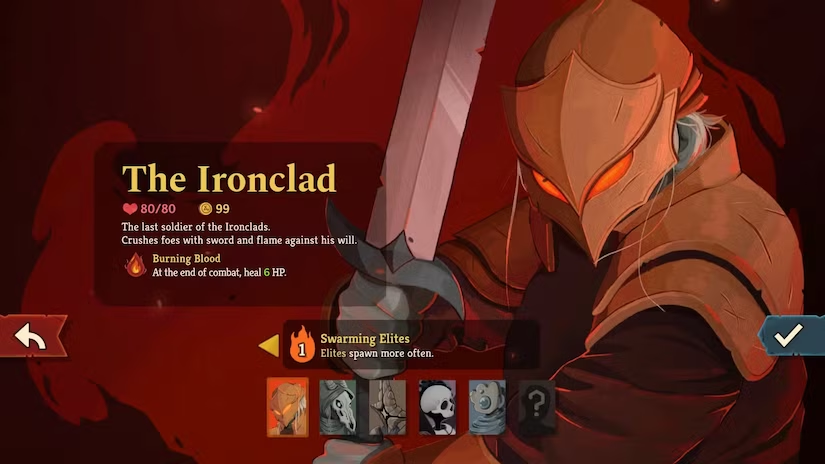
My quick read
If I want the lowest-friction start in Slay the Spire 2, I still open Ironclad first. He gives me enough raw stability to learn enemy pacing, elite pressure, and route greed without making every bad draw feel fatal. The class is strong because the floor is high, not because every deck automatically builds itself.
When I pick this character
I pick Ironclad when I want a run that tells me the truth early. If my deck is weak, I usually feel it fast. If the deck is coming together, Ironclad turns that into clean elite kills and steady map progress without a lot of extra bookkeeping. He is also the class I use when I want to relearn the game after a break, because the turn patterns stay readable even when the run gets messy.
What I prioritize early
- I want one reliable damage plan, one reliable block plan, and at least one upgrade target that improves weak hands.
- I care more about immediate fight quality than future fantasy. If a card only becomes good after several other pieces arrive, I usually skip it.
- I respect frontloaded damage more than greedy scaling in the first stretch, because Ironclad’s sustain works best when I am already ending fights in decent shape.
- If my early elite route already looks tense, I almost always take the boring stabilizer over the clever payoff. Ironclad rewards that discipline more than people think.
Best build paths
- Strength tempo is still the cleanest path when the run offers early attacks that scale well and let me punish elites before they stabilize.
- Exhaust value becomes excellent once the deck has enough glue pieces. This is usually the line that makes awkward Ironclad hands feel much sharper.
- Slower block shells can absolutely win, but I only commit when the defensive backbone shows up naturally. I do not force a late-game fantasy deck on floor one.
When Ironclad is really working for me, the deck usually looks unfairly normal. It is just a pile of honest cards that stop bricking and start winning every mid-length fight.
Common mistakes
- Trusting Burning Blood to cover a bad deck for too long.
- Adding too many expensive attacks and then wondering why every turn feels clunky.
- Drafting defensive payoff cards before the deck can actually survive long enough to use them well.
Who should skip this character
If I specifically want high-agency combo turns, heavy draw manipulation, or a class that rewards clever sequencing more than raw fundamentals, Ironclad is not the first guide I open. He is the best teacher in the roster, but not the most expressive class once I know I want something trickier.